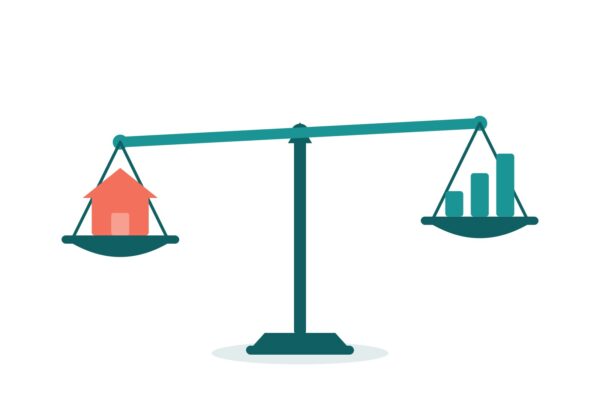


This week’s topic might seem a bit narrow, but bear with me as few personal finance questions create as much spirited discussion as this one: the long-standing debate between paying off a mortgage early and investing the funds that would otherwise do so. However, before we dive in… understand that this Weekly Whiteboard is as much about human behavior as finances.
On one side are the mortgage eliminators. They dream of a paid-off house, a celebratory final payment, and perhaps a small backyard ceremony where the amortization schedule is placed gently into a paper shredder while playing a song from the 80s on a boom box. On the other side are the investors. They look at a relatively low mortgage rate, compare it with the stock market’s long-term historical returns, and wonder why anyone would rush to repay inexpensive debt. Both sides have a point. Both sides also have assumptions. And, as usual, the assumptions are where the rubber meets the road.
The Math (more or less)
Paying off or paying “extra” is a concept I discuss frequently with clients. Paying extra toward a mortgage produces a return roughly equal to the interest rate you avoid. If your mortgage rate is 6%, an additional principal payment effectively gives you a guaranteed 6% return before considering taxes or other complications. You will not see that return deposited into an account. Instead, it appears as interest you never have to pay, which is less exciting but just as real. If you have enough to pay off the mortgage entirely, that is a separate issue as a one-time payoff can cause liquidity (access to cash) worries. But the same math applies as above… only the scale is much larger.
Investing in lieu of paying off or paying “extra” offers a different proposition. A diversified portfolio may earn more than the 6% interest rate over a long period, but that return is not guaranteed. It will arrive unevenly, accompanied by market declines, alarming headlines, and occasional predictions that civilization will end before the closing bell. This is the essential comparison:
Paying down the mortgage offers a certain return based on avoided interest.
Investing offers a potentially higher return in exchange for uncertainty and risk.
Here comes a key element to this decision… the mathematically attractive answer depends heavily on the mortgage rate. A 3% mortgage presents a very different decision from an 8% mortgage. The higher the rate, the more compelling early repayment becomes. The lower the rate, the stronger the case for investing, assuming you have enough time and tolerance to endure market volatility. Of course, personal finance would be much easier if arithmetic were the only consideration. Unfortunately, human beings insist on having emotions, taxes, unexpected expenses, and opinions about debt.
A brief tax point…
People sometimes reduce the comparison to mortgage rate versus expected investment return. That is useful, but incomplete. Mortgage interest may be deductible if you itemize deductions and meet the applicable requirements. Many homeowners, however, receive little or no incremental tax benefit because they take the standard deduction. A tax deduction also does not make interest free. Spending a dollar to save a fraction of a dollar is not a loophole. It is still spending money (there is a great Seinfeld scene where Jerry tries to explain this to Kramer… to no avail). Investment returns may also be reduced by taxes. Interest, dividends, capital gains, and account type all matter. A 7% return inside a tax-advantaged retirement account is not identical to a 7% return in a taxable account. The clean comparison is therefore more than mortgage interest rate versus market return and is closer to: after-tax cost of the mortgage versus the after-tax, risk-adjusted return you can reasonably expect from investing. That sentence is less suitable for a bumper sticker (or even this Weekly Whiteboard), but it is much more accurate for decision-making purposes.
Another consideration is one that I alluded to earlier – liquidity. Money invested in a brokerage account is generally accessible. Money used to pay down a mortgage becomes home equity. Home equity is valuable, but it is not especially liquid. You cannot easily use a paid-off guest bedroom to cover an emergency expense. To access the equity, you may need to sell the house, obtain a home equity loan, or refinance, none of which is guaranteed to be quick, cheap, or convenient. Before accelerating mortgage payments, it is usually wise to have:
An adequate emergency reserve
No higher-interest debt demanding attention
A sensible level of retirement saving
Cash available for known near-term expenses
Becoming house-rich and cash-poor can feel wonderful right up until the roof decides it has reached the end of its natural life.
Humanity Vs. Spreadsheetanity (look it up… okay, actually, don’t)
The investing argument often assumes that the money not sent to the mortgage will actually be invested. That is not always what happens. There is an enormous difference between saying, “I will invest an extra $1,000 each month,” and discovering, several years later, that the money was gradually converted into restaurant meals, upgraded vehicles, and a collection of subscriptions no one remembers authorizing. If the realistic choice is between paying extra on the mortgage and consistently investing in a diversified portfolio, compare those two options. However, if the realistic choice is between paying extra on the mortgage and spending the money, mortgage repayment may win rather decisively. The best strategy is not the one that performs beautifully in a spreadsheet while being completely incompatible with the person using it.
A corollary to this is that paying off a mortgage can provide something that does not appear in conventional return calculations: peace of mind. For some people, debt is simply a financial tool. For others, it is a low hum of anxiety in the background of daily life. Eliminating the mortgage may create a sense of independence, reduce fixed monthly expenses, and make retirement feel more secure. That benefit should not be dismissed merely because it cannot be expressed to two decimal places. At the same time, we should avoid treating a paid-off mortgage as the final stage of human enlightenment (although pretty sure it is listed as one of Gautama Buddha’s Four Stages). Owning a home without debt does not eliminate property taxes, insurance, maintenance, or failure of your HVAC system on the hottest weekend of the summer! Financial freedom is rarely one event. It is a collection of choices that gradually creates flexibility.
Time Horizon Changes the Answer
An investor with 25 years before retirement may reasonably accept market volatility in pursuit of long-term growth. Someone preparing to retire in two years may place greater value on reducing required monthly expenses. Even then, the answer is not automatic. A retiree with substantial liquid assets and a low fixed-rate mortgage may prefer to keep the loan. Another retiree may sleep much better knowing the house is fully paid for. In my view, some important questions are: How long do you expect to remain in the home? When might you need the invested money? How much investment risk can you tolerate emotionally and financially? Would paying off the mortgage leave enough liquidity? And the list goes on. For example, forgoing an employer match in your 401(k) in order to accelerate a low-rate mortgage is often difficult to justify. The match may provide an immediate benefit that neither mortgage repayment nor ordinary investing can easily duplicate.
Fortunately, this is not a moral referendum requiring you to select your allegiance to Team Mortgage or Team Market for the remainder of your natural life – both are available to you. A household might direct part of its excess cash flow toward investments and part toward additional principal. This approach may not produce the highest theoretical ending wealth under one particular set of assumptions, but it offers several practical advantages. Another option is to invest during the working years while maintaining the flexibility to pay off the remaining mortgage near retirement. This can preserve liquidity and allow the decision to be revisited as circumstances change.
So, Which One Should You Choose?
As a general framework, paying down the mortgage becomes more attractive when the interest rate is high, retirement is near, cash reserves are already strong, investment risk is uncomfortable, or being debt-free would materially improve your peace of mind.
Investing becomes more attractive when the mortgage rate is low, the time horizon is long, liquidity is important, retirement accounts offer valuable tax benefits or employer matching, and you can tolerate market declines without abandoning the plan.
A blended strategy becomes attractive when the numbers do not clearly favor one side, or when you value both financial flexibility and the emotional satisfaction of reducing debt. The real mistake is often not choosing the “wrong” side; rather, it is making the decision without examining the assumptions or allowing excess cash flow to disappear while endlessly debating what should be done with it.
The larger point (in my opinion) is that, at first glance, this appears to be a question about interest rates and investment returns. At a deeper level, it is a question about what money is for. Is it meant to maximize future wealth? Reduce present anxiety? Create flexibility? Protect your family? Allow you to sleep soundly? Etc. Like many/most of my client conversations, there is no universally correct answer because households are not equations (as much as I would love them to be). The right choice is the one that fits your full financial plan, your temperament, and the life you are trying to build. Run the numbers. Respect uncertainty. Preserve flexibility. Then make a deliberate choice.